

















Rabb Da Radio 3 (2026): Tarsem Jassar & Nimrat Khaira Return - April 3 Release
April 3, 2026: Rabb Da Radio 3 Punjabi movie with Tarsem Jassar, Nimrat Khaira. Harry Bhatti returns. Jass Grewal writes. Vehli Janta Films. Full cast & details.
Rabb Da Radio 3: The Beloved Punjabi Franchise Returns With Its Heart Still Beating
Release Date: April 3, 2026 | Genre: Drama, Romance, Family | Language: Punjabi
Some films don't just entertain—they become part of family conversations, wedding playlists, and nostalgic memories. Rabb Da Radio did exactly that when it released in 2017. It wasn't the biggest budget film or packed with action sequences, but it touched something deeper: the heart of Punjabi culture, family bonds, and a simpler time when love meant looking at someone and just knowing they were the one.
Now, nine years after the original and seven years after Rabb Da Radio 2 (2019), the franchise returns with Rabb Da Radio 3—and this time, it's bringing two of Punjabi entertainment's brightest stars: Tarsem Jassar and Nimrat Khaira. Directed once again by Harry Bhatti, written by Jass Grewal, and produced by Manpreet Singh Johal under Vehli Janta Films, this April 3, 2026 release isn't just another sequel—it's a homecoming.
What Made Rabb Da Radio Special?
Before diving into Part 3, let's understand why this franchise matters so much to Punjabi audiences.
Rabb Da Radio (2017) wasn't supposed to be a blockbuster. It was Tarsem Jassar's debut as an actor, featuring him opposite Simi Chahal and Mandy Takhar. Set in 1970s-80s Punjab, the film told a heartbreakingly simple story: Nek Singh (Tarsem Jassar), a poor young man, falls in love with Guddi (Simi Chahal), whose family has wealth and status. Their love faces opposition not because of incompatibility, but because of economic differences—a reality that still resonates in Punjabi families today.
What made it work? Authenticity. The film looked like 1980s Punjab—not a sanitized version, but the real thing. Vintage cars, old-style clothing, families gathered around a single radio listening to programs together. Director Harry Bhatti and co-director Tarnvir Singh Jagpal paid meticulous attention to period details.
The music was soulful. Songs like "Attwadi" (which had already made Tarsem Jassar famous as a singer) fit perfectly into the narrative. But it was the emotional honesty that clinched it—scenes that made you cry not because of dramatic tragedy, but because they reminded you of your own family, your own grandparents' stories.
The film earned ₹16 crore at the box office (massive for a debut actor), won 10 awards including Best Film (Critics), and more importantly, earned a permanent place in Punjabi pop culture.
Rabb Da Radio 2: Continuing The Story
Rabb Da Radio 2 (2019) did something rare in Punjabi cinema—it actually continued the story instead of being a standalone sequel. The film followed Manjinder Singh (Tarsem Jassar) and Guddi (Simi Chahal) 16 years after the first film. Now married, Manjinder brings Guddi to his maternal home only to discover that his once close-knit family of four maternal uncles has fractured. Walls exist not just between houses but between hearts.
The sequel explored how families drift apart, how misunderstandings create rifts, and how sometimes it takes an outsider (Guddi) to help heal old wounds. It wasn't just about romantic love anymore—it was about familial love, the importance of togetherness, and the value of communication.
Part 2 grossed approximately ₹18-20 crore and earned critical acclaim for maintaining the franchise's emotional core while expanding its themes.
And now, after seven years, Rabb Da Radio 3 arrives. But this time with a twist.
Rabb Da Radio 3: A Fresh Chapter With New Faces
Here's what's fascinating about Part 3: while Tarsem Jassar returns, he's now paired with Nimrat Khaira instead of Simi Chahal. This isn't a reboot—it's the same universe, the same franchise DNA—but it's a new story, likely focusing on a different generation or different characters within the same family framework.
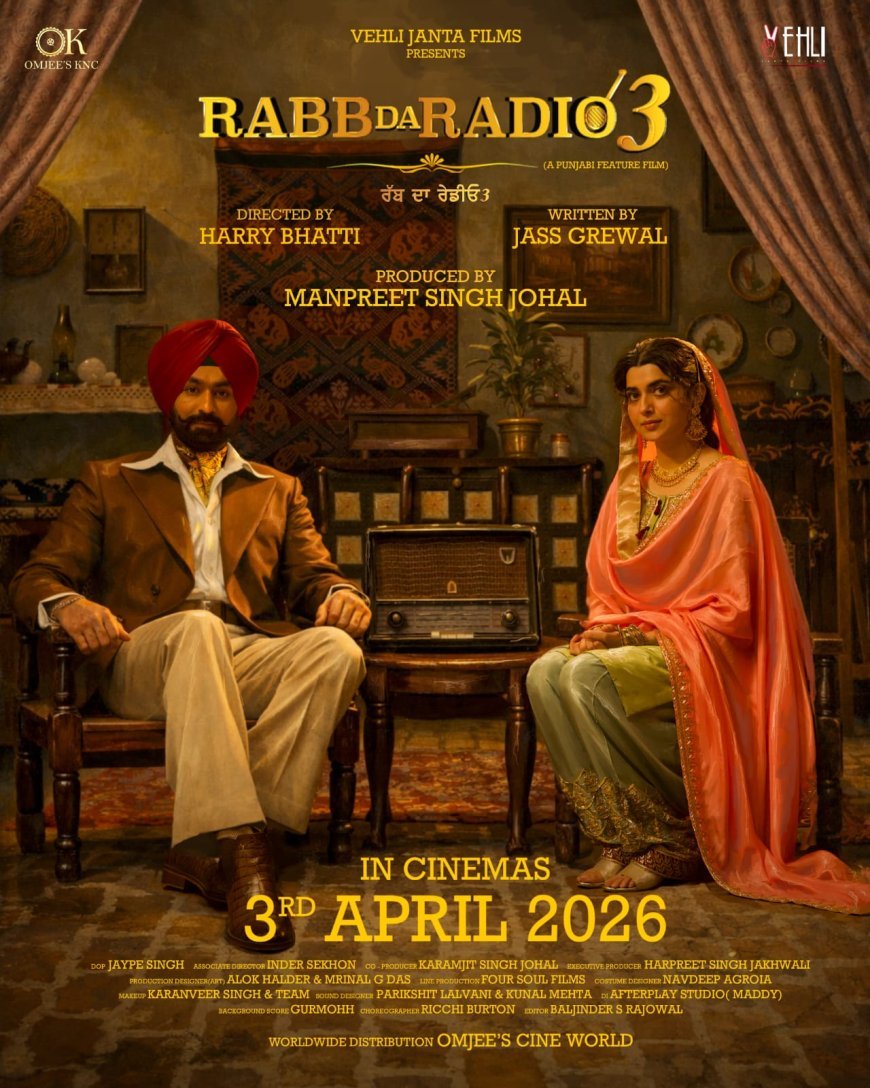
The poster reveals a period setting again, with both leads dressed in traditional attire seated beside a vintage radio—the symbolic heart of the franchise. The visual aesthetic suggests the film stays true to the series' commitment to showcasing Punjab's cultural heritage and family-centered storytelling.
Why The Cast Change?
While Simi Chahal isn't returning (or perhaps appears in a supporting role—full cast details are still emerging), bringing in Nimrat Khaira is a strategic and creative masterstroke. Here's why:
Nimrat is a proven actress: Her work in "Lahoriye" (2017), "Afsar" (2018) alongside Tarsem, "Saunkan Saunkne" (2022), and "Jodi" (2023) has established her as a versatile performer capable of handling both comedy and emotional depth.
Nimrat is a musical powerhouse: As a singer, she won "Voice of Punjab" Season 3 and has delivered massive hits like "Ishq Kacheri," "Designer," and "Salute Wajde." Her musical background adds another layer to a franchise where songs aren't just background filler—they're emotional storytelling tools.
Fresh chemistry: Tarsem and Nimrat previously worked together in "Afsar," where their on-screen pairing received positive response. Reuniting them in the more emotionally grounded world of Rabb Da Radio could create magic.
Generational appeal: Nimrat has a massive following among younger Punjabi audiences (9 million Instagram followers), while Tarsem holds respect across age groups. Together, they bridge generations—crucial for a franchise that prides itself on family-friendly content.
Tarsem Jassar: The Heart of Rabb Da Radio
Let's talk about the man who started it all.
Tarsem Singh Jassar, born July 4, 1986, in Jassar village, Ludhiana district, isn't just an actor—he's a complete artist. Singer, lyricist, songwriter, producer, and now one of Punjabi cinema's most respected actors.
Before Rabb Da Radio
Tarsem's journey began in music. Along with his partner Kulbir Jhinjer, he launched Vehli Janta Records in 2013—the same production house producing Rabb Da Radio 3. His debut song "Attwadi" (2014) immediately established him as a voice that spoke to rural Punjabi youth—songs about authenticity, cultural pride, and staying true to one's roots.
His lyrics weren't about flashy cars or foreign visas (common themes in Punjabi pop). They were about "anah" (reputation), moral values, motivation, and real Punjabi life. Songs like "Wrangler," "Sacred Games," and "Galwakdi" became anthems because they felt real.
The Acting Career
When Rabb Da Radio offered him the lead role in 2017, Tarsem had zero acting experience. But what he brought was authenticity—he looked, spoke, and carried himself like someone who actually came from a Punjab village, not from an acting school.
Since then, his filmography includes:
- Sardar Mohammad (2017): A partition-era story about a Muslim boy raised by a Sikh family - Daana Paani (2018): 1962 war-era romance - Afsar (2018): Opposite Nimrat Khaira - Rabb Da Radio 2 (2019): Reprising his iconic role - Uda Aida (2019): Family comedy - Galwakdi (2022): Romantic comedy - Maa Da Ladla (2022): Mother-son relationship - Mastaney (2023): Historical epic
What makes Tarsem different? He doesn't chase stardom—he chooses stories that matter. Nearly every film he's done explores family relationships, cultural values, or historical events significant to Punjab. Even in commercial films, there's substance.
In Rabb Da Radio 3, he returns to the franchise that made him a star—but now as an established actor with a decade of experience, capable of bringing even more emotional nuance to whatever role he's playing.
Nimrat Khaira: Punjab's Sweetheart
Nimratpal Kaur Khaira, born August 8, 1992 (some sources say December 22), in Mustafapur, Punjab, represents the new generation of Punjabi artists who excel in both music and acting.
The Singing Journey
Nimrat's musical journey is inspirational. She started learning classical music in third grade from Sushil Narang. When she was in 12th standard, she auditioned for "Awaaz Punjab Di" but got eliminated after reaching Top 20. In 2011, she tried "Voice of Punjab Season 2" and was eliminated one day before the grand finale.
But she didn't give up. In 2012, she returned for Voice of Punjab Season 3 and won the entire competition.
Her professional singing career launched with "Rabb Karke" (2015) alongside Nishawn Bhullar. Her breakthrough came with "Ishq Kacheri" (2016), followed by a string of massive hits:
- "SP De Rank Wargi" (2016) - "Rohab Rakhdi" (2017) - "Dubai Wale Sheikh" (2017) - won Best Female Vocalist at Brit Asia Awards - "Suit" (2017) - "Designer" (2017) - "Salute Wajde" - "Brobar Boli"
Her songs consistently trend on YouTube, often crossing 100+ million views. What distinguishes her work? A voice that's powerful yet emotive, songs that balance Punjabi pride with relatable emotions, and an authentic connection to Punjabi culture despite industry pressures to westernize.
The Acting Career
Nimrat's acting debut came with "Lahoriye" (2017) opposite Amrinder Gill—a film exploring cross-border love during partition. She was nominated for Best Debut Performance and proved she wasn't just a singer trying acting—she was a genuine performer.
Her filmography includes:
- Afsar (2018): With Tarsem Jassar (their first collaboration) - Saunkan Saunkne (2022): Massive commercial hit with Ammy Virk and Sargun Mehta - Jodi (2023): With Diljit Dosanjh - Teeja Punjab: With Amberdeep Singh - Akaal: The Unconquered (2025): Historical drama
In Rabb Da Radio 3, Nimrat gets to do what she does best: play a grounded, culturally rooted Punjabi character in a period setting. Given the franchise's focus on family drama and emotional storytelling, expect her to deliver one of her strongest performances yet.
The Creative Team: Why This Matters
Director: Harry Bhatti
Harry Bhatti co-directed the original Rabb Da Radio (with Tarnvir Singh Jagpal) and directed Part 2 solo. He returns for Part 3, ensuring directorial continuity—crucial for maintaining the franchise's distinct tone.
Bhatti's strength lies in creating authentic period settings and extracting natural performances from actors. He doesn't rely on melodrama or over-the-top emotions. His films breathe—scenes unfold naturally, dialogues feel conversational, and emotions emerge organically.
Having directed both Tarsem and now working with Nimrat, Bhatti understands how to balance star power with story requirements—never letting performances overshadow narrative, but also giving actors space to shine.
Writer: Jass Grewal
Jass Grewal has written all three Rabb Da Radio films. His consistency ensures the franchise maintains its voice—the particular way it explores family dynamics, the specific emotional beats it hits, the cultural authenticity it preserves.
Grewal's writing doesn't chase trends. He writes about what matters to Punjabi families across generations: respect for elders, importance of keeping family united, balancing tradition with personal desires, and understanding that love—whether romantic or familial—requires sacrifice and communication.
Having him write Part 3 means fans can expect the same emotional depth, cultural specificity, and narrative integrity that made the first two films resonate so deeply.
Producer: Manpreet Singh Johal / Vehli Janta Films
Manpreet Singh Johal has produced all three films under Vehli Janta Films—the production house co-owned by Tarsem Jassar. This isn't a corporate entity churning out content; it's a creator-driven production house that makes what it believes in.
The fact that Vehli Janta Films presents this film (also partnered with Omjee's Cine World for distribution) means it will get proper theatrical release worldwide—crucial for a franchise with a massive diaspora following in Canada, UK, USA, and Australia.
The Supporting Cast & Crew
While full cast details are still emerging, the poster credits several key creative positions:
DOP (Director of Photography): Jaype Singh - responsible for the film's visual language, ensuring period authenticity in cinematography
Associate Director: Inder Sekhon - assists in maintaining directorial vision and managing on-set execution
Co-Producer: Karamjit Singh Johal - sharing production responsibilities alongside Manpreet Singh Johal
Executive Producer: Harpreet Singh Jakhwali - overseeing production logistics and coordination
Production Designers/Art: Alok Halder & Mrinal G Das - crucial roles in creating authentic period settings. Their work will define the film's visual authenticity—vintage furniture, period-appropriate props, historically accurate set designs.
Line Production: Four Soul Films - handling day-to-day production operations
Costume Designers: Navdeep Agroja - ensuring period-accurate clothing that looks authentic without being costume-y
Makeup: Karanveer Singh & Team - period-appropriate makeup styling
Sound Designer: Parikshit Lalvani & Kunal Mehta - critical for a film where the radio itself is a central element. Sound design will enhance emotional moments and create period atmosphere.
VFX: Afterplay Studio (Maddy) - likely minimal, used only where necessary to enhance period authenticity
Background Score: Gurmohh - the musical emotional backbone of the film
Choreographer: Ricchi Burton - handling any dance sequences, likely traditional rather than contemporary
Editor: Baljinder S Rajowal - responsible for pacing and maintaining emotional rhythm
This crew represents a mix of experienced Punjabi film technicians who understand the specific requirements of period dramas and the emotional tone required for this franchise.
What To Expect From Rabb Da Radio 3
While the complete plot hasn't been revealed, here's what we can reasonably expect based on the franchise's DNA and the casting:
Another Period Setting
The vintage radio front and center in the poster, the period costumes, the overall aesthetic—all suggest another journey into Punjab's past, likely 1970s-90s. The radio remains symbolically important, representing an era when families gathered together for entertainment, when community listening was common, and when technology brought people together rather than isolating them.
Family-Centered Drama
The franchise's core has always been family relationships. Part 3 will likely explore another dimension of family life—perhaps focusing on a different couple within the same universe, or exploring an earlier generation, or showing how the same family dynamics play out in a different context.
Romance Grounded in Reality
Don't expect love at first sight, dramatic declarations, or over-the-top romantic gestures. Rabb Da Radio's love stories have always been quiet, realistic, complicated by family expectations, economic realities, and cultural norms. Tarsem and Nimrat's characters will likely face obstacles that feel real rather than contrived.
Emotional Depth Without Melodrama
Harry Bhatti's direction style avoids melodrama. Expect scenes that make you cry not because someone's dying or leaving forever, but because they capture the small, heartbreaking moments that define real relationships—a mother's worry, a father's silent pride, a lover's uncertainty, an elder's wisdom.
Music That Matters
Given that both leads are accomplished singers, expect the soundtrack to be spectacular. Songs won't just be commercial insertions—they'll drive the narrative forward, reveal character emotions, and become part of the story itself.
The first song was strategically released on International Women's Day (March 8, 2026), suggesting the film honors female characters' strength and centrality—continuing the franchise's tradition of writing well-rounded, complex female roles.
The Release Strategy: April 3, 2026
The April 3, 2026 release date is strategically chosen:
Post-Vaisakhi Timing: Vaisakhi (Sikh new year and harvest festival) falls on April 13-14. Releasing 10 days before means the film benefits from the festive mood building up to the holiday while avoiding direct competition with Vaisakhi-specific releases.
Family Time: Early April often coincides with school holidays in many regions, meaning families have time to visit theaters together—perfect for a family-oriented film.
Pre-Summer Window: Before the intense summer heat in North India makes theater visits uncomfortable, but after the peak winter wedding season when many Punjabi families are busy with marriages.
Nostalgia Factor: The original Rabb Da Radio released March 31, 2017. Part 2 released March 29, 2019. Releasing Part 3 in early April maintains the tradition of late March/early April releases—fans will associate this time of year with the franchise.
Worldwide Distribution
Omjee's Cine World handling worldwide distribution is significant. Omjee Group is one of the largest distributors of Punjabi cinema internationally, meaning Rabb Da Radio 3 will get theatrical releases in:
- India: Punjab, Haryana, Delhi, Himachal Pradesh, Chandigarh - Canada: Particularly British Columbia, Ontario (Toronto, Brampton, Mississauga) - UK: Birmingham, London, Leicester - USA: California, New York, New Jersey - Australia: Melbourne, Sydney - New Zealand: Auckland
The Punjabi diaspora is massive and movie-hungry, particularly for content that reminds them of their cultural roots. Rabb Da Radio's authentic portrayal of Punjabi culture makes it especially appealing to NRIs (Non-Resident Indians) who want their children to understand the culture they came from.
Box Office Expectations
Let's be realistic about commercial prospects:
Rabb Da Radio (2017) - ₹16 crore Rabb Da Radio 2 (2019) - ₹18-20 crore
For Part 3, here's a reasonable projection:
Domestic (India): ₹20-25 crore International: ₹15-18 crore Total Potential: ₹35-43 crore
Why the increase?
1. Star Power: Both Tarsem and Nimrat are bigger names now than in 2019. Nimrat's recent hits like "Saunkan Saunkne" (₹22+ crore) prove she can pull audiences.
2. Franchise Value: The Rabb Da Radio brand has goodwill. People know what to expect and will trust it.
3. Post-Pandemic Theatrical Hunger: Audiences, especially families, are back in theaters for content that feels worth the outing.
4. Music Advantage: Pre-release songs can trend on YouTube, creating publicity and drawing in audiences who come for the music.
However, it faces competition from other April releases and the general challenge that Punjabi films face smaller theatrical windows than Bollywood productions.
Why Rabb Da Radio Matters Beyond Box Office
Here's what many miss when analyzing Punjabi cinema: it's not just about entertainment—it's about cultural preservation.
For Punjabi youth in Toronto, Birmingham, or Sydney who've never lived in Punjab, films like Rabb Da Radio are windows into their parents' and grandparents' world. They see village life, traditional customs, family structures, and values that might seem foreign to them despite being part of their heritage.
The franchise doesn't preach. It doesn't lecture about "maintaining culture." It simply shows, with love and authenticity, how things used to be—and in many rural areas, how things still are. It validates older generation's experiences while helping younger ones understand why certain values matter.
Moreover, in an era where Punjabi cinema sometimes chases Bollywood formulas or focuses heavily on Canada-based stories, Rabb Da Radio stays rooted in Punjab. It's unapologetically Punjabi—not in a jingoistic way, but in the specificity of its cultural details, its language, its worldview.
What Fans Are Saying
Social media response to the poster and first song release has been overwhelmingly positive:
- Tarsem Jassar's fans appreciate him returning to the role that defined his acting career
- Nimrat Khaira's massive following is excited to see her in a period drama role
- Older audiences who loved Parts 1 and 2 are curious how Part 3 continues or expands the story
- The Women's Day release of the first song resonated with female audiences who appreciate the franchise's well-written female characters
The only concern some fans have expressed is whether changing the female lead affects continuity. However, most seem willing to trust the creative team given their track record.
The Competition & Market Context
April 2026 will be busy:
- Multiple Punjabi films targeting the same audience - Bollywood releases competing for screens - Regional films from other languages However, Rabb Da Radio 3 has advantages:
- Brand recognition: People know and love this franchise - Star power: Tarsem and Nimrat both have dedicated fanbases - Musical appeal: Pre-release songs can create massive buzz - Family-friendly: Multiple generations can watch together - Cultural authenticity: Offers something other films don't
The film doesn't need to be the biggest earner—it needs to satisfy its core audience and maintain the franchise's reputation for quality, emotional storytelling.
How To Stay Updated
Social Media: - Follow Tarsem Jassar: @tarsemjassar (Instagram, Facebook) - Follow Nimrat Khaira: @nimratkhairaofficial (Instagram - 9M followers) - Track #RabbDaRadio3 and #RDR3 hashtags - Follow Vehli Janta Films for official updates
Music Platforms: - YouTube: Vehli Janta Records channel for song releases - Spotify, Apple Music, Amazon Music for soundtrack - Expect 2-3 songs before release, plus background score album
Trailer & Promotions: - Official trailer expected mid-March 2026 (2-3 weeks before release) - TV appearances on Punjabi entertainment channels - Radio tours on Punjabi FM stations - Possible promotional events in major cities with significant Punjabi populations
Theater Listings: - India: PVR, INOX, Cinepolis - Canada: Cineplex, Landmark Cinemas - UK: Cineworld, Odeon - USA: AMC, Regal - Australia: Event Cinemas, Hoyts
The Emotional Core That Never Changes
Here's what makes Rabb Da Radio special across all three films: it understands that the most profound emotions aren't always the loudest ones.
A mother's silent worry. A father's unspoken pride. A lover's uncertain glance. A family's gradual drifting apart. A radio program that brings everyone together for one evening. These small, quiet moments—Rabb Da Radio has always excelled at capturing them.
In our age of Instagram reels and TikTok videos, where everything moves fast and loud, this franchise slows down. It asks you to sit with emotions, to feel them fully, to recognize them in your own life.
That's why grandmothers, parents, and teenagers can all watch it together and each find something that speaks to them. The grandmother remembers when life was like this. The parents recognize the family dynamics they're navigating. The teenagers see love portrayed in a way that feels real rather than fantasized.
Final Verdict: Worth The Wait?
Seven years between Part 2 and Part 3 is a long time. But perhaps that gap was necessary—to let the franchise breathe, to allow the creative team to find the right story to tell, to ensure they weren't just cashing in on a brand name.
The decision to bring in Nimrat Khaira shows confidence—they're not just repeating the formula but evolving it. The retention of Harry Bhatti and Jass Grewal shows respect for the franchise's DNA.
Strengths: - Established franchise with proven emotional resonance - Powerhouse leads (Tarsem + Nimrat) with both acting and musical credibility - Creative continuity (same director, writer, producer) - Authentic period setting and cultural specificity - Family-friendly content with multi-generational appeal - Strong production values and experienced technical crew - Excellent distribution ensuring wide theatrical release
Potential Concerns: - Lead actress change might confuse some viewers expecting continuity - Seven-year gap means new audience may not know the franchise - Period dramas require patience—may not appeal to audiences wanting fast-paced content - Competition from multiple releases in the same window
Bottom Line: If you appreciate Punjabi cinema that prioritizes emotional authenticity over spectacle, cultural depth over glamour, and family bonds over individual heroics, mark April 3, 2026 on your calendar. If the first two films made you cry, laugh, and call your parents afterward, Part 3 deserves your theater visit.
This isn't just a movie—it's a gathering. Like the families in the film gathering around a radio, audiences will gather in theaters to experience something that reminds them why stories matter, why culture matters, why family matters.
And in a world that often feels chaotic and disconnected, that's exactly the kind of cinema we need.
Rabb Da Radio 3 (2026) - Essential Information
Release Date: April 3, 2026 Language: Punjabi Genre: Drama, Romance, Family Runtime: TBA (likely 130-140 minutes based on previous films)
Cast: Tarsem Jassar (Lead) Nimrat Khaira (Lead) Additional cast to be announced
Director: Harry Bhatti Writer: Jass Grewal Producer: Manpreet Singh Johal Co-Producer: Karamjit Singh Johal Executive Producer: Harpreet Singh Jakhwali
Technical Team: DOP: Jaype Singh Editor: Baljinder S Rajowal Music: TBA (Background Score: Gurmohh) Art Directors: Alok Halder, Mrinal G Das Sound Design: Parikshit Lalvani, Kunal Mehta Choreography: Ricchi Burton
Presented By: Vehli Janta Films Distributed By: Omjee's Cine World (Worldwide)
Certification: TBA (Expect U or U/A for family viewing) Format: Theatrical Release (Worldwide)
Previous Films in Franchise: Rabb Da Radio (March 31, 2017) - ₹16 crore Rabb Da Radio 2 (March 29, 2019) - ₹18-20 crore
Nine years after the journey began, the radio still plays. The voices still matter. The hearts still connect. April 3, 2026—the family gathers again.
Radio Haanji 1674 AM is Austalia's Punjabi community radio station.
Listen free at haanji.com.au | Spotify | Apple Podcasts | iOS App | Android App
Serving the Punjabi community in Australia, Canada, Singapore and world wide.
What's Your Reaction?