



























































Apollo 11 – Was the Moon Landing Real or the Greatest Hoax in History? | The Deep Talk – Radio Haanji Punjabi Podcast
Host:-
 Dr. Sandeep Kaur
 Gautam Kapil
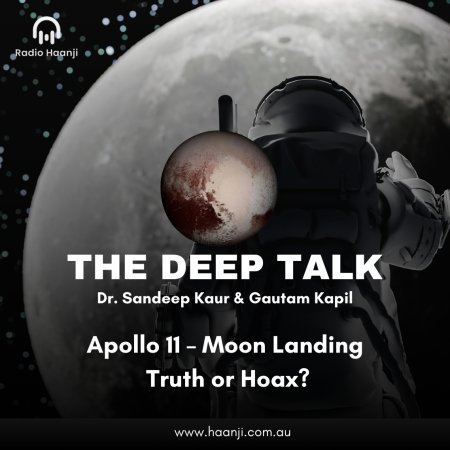
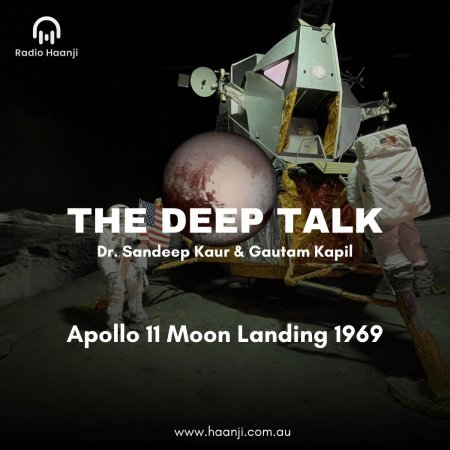
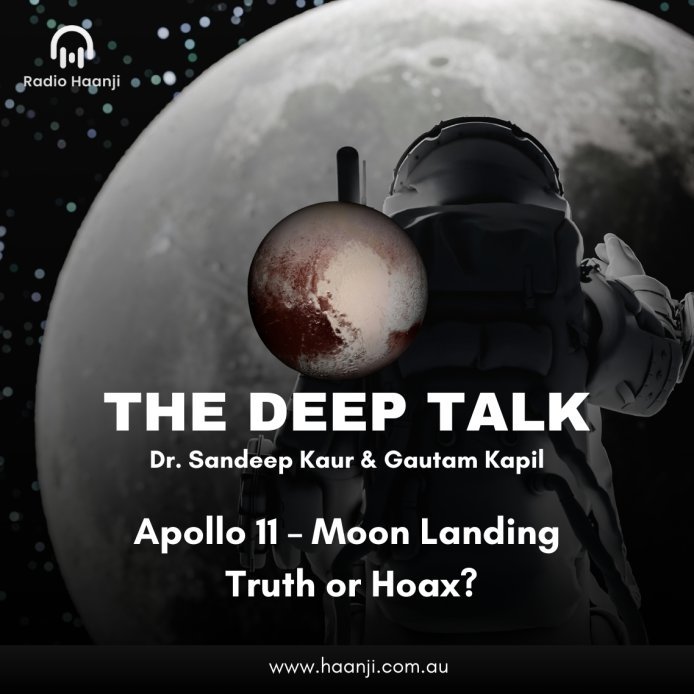
Radio Haanji's The Deep Talk, hosted by Gautam Kapil with special guest Dr. Sandeep Kaur, explores one of the biggest questions in human history — was the Apollo 11 moon landing real, or was it faked? Listen to Australia's favourite Punjabi podcast and decide for yourself.
Apollo 11: Was the Moon Landing Humanity's Greatest Achievement — or the Greatest Lie Ever Told?
On July 20, 1969, NASA astronaut Neil Armstrong stepped off a ladder and placed his boot on the surface of the Moon. More than half a billion people watched it live on television. It was called the greatest achievement in human history — the moment mankind reached beyond its own world for the very first time.
But not everyone believed it. And decades later, millions of people around the world still don't.
In the latest episode of The Deep Talk on Radio Haanji — Australia's number one Punjabi radio station and podcast — host Gautam Kapil sits down with Dr. Sandeep Kaur to explore the Apollo 11 moon landing from every angle. Was it a real triumph of human courage and science? Or was it an elaborate hoax staged by the United States government during the height of the Cold War?
"Curiosity meets truth — let's dive in and discover it together."
The Mission — What NASA Says Happened
The Apollo 11 mission launched on July 16, 1969, carrying three astronauts — Neil Armstrong, Buzz Aldrin, and Michael Collins. After a four-day journey of roughly 384,000 kilometres, the lunar module named Eagle separated from the main spacecraft and descended toward the Moon's surface.
Armstrong and Aldrin landed in a region called the Sea of Tranquility. They spent just over two hours walking on the Moon, collecting rock and soil samples, planting the American flag, and communicating with Mission Control back in Houston, Texas. Collins, meanwhile, orbited the Moon alone in the command module.
The mission returned safely to Earth on July 24, 1969, with 21.5 kilograms of lunar material. It was, by any measure, an extraordinary undertaking.
Why Do So Many People Think It Was Faked?
The conspiracy theories around Apollo 11 are some of the most enduring in modern history. They didn't just come from fringe thinkers — they have been debated by scientists, filmmakers, engineers, and ordinary people for over five decades. In the episode, Gautam Kapil and Dr. Sandeep Kaur examine the most well-known arguments.
The Flag Was Waving — But There Is No Wind on the Moon
In the footage, the American flag appears to ripple and wave as Armstrong and Aldrin plant it into the lunar soil. Critics point out that the Moon has no atmosphere and therefore no wind. How can a flag wave in a vacuum? NASA's explanation is that the flag was disturbed by the astronauts' movements and continued vibrating in the absence of air resistance — which, rather than slowing it down, actually allowed the motion to continue longer than it would on Earth.
The Shadows Don't Line Up
Several photographs from the mission show shadows falling in different directions, which conspiracy theorists argue is evidence of multiple artificial light sources — like a film studio setup. Scientists counter that the uneven and rocky terrain of the lunar surface naturally causes shadows to appear at different angles, even when there is only one light source, the Sun.
There Are No Stars in Any of the Photos
This is one of the most commonly raised questions. The lunar sky in all photographs is completely black, with no stars visible. Surely, with no atmosphere to obscure them, the stars should be spectacular. The photographic explanation is straightforward: the cameras were set to expose for the brightly lit lunar surface. At those settings, the much dimmer stars simply would not show up — the same reason you cannot see stars in daylight photos taken on Earth.
The Van Allen Radiation Belts
This is the argument that scientists take most seriously. The Van Allen belts are zones of intense radiation that surround Earth. Passing through them would expose astronauts to significant radiation levels. Critics argue this exposure would have been lethal. NASA acknowledges the belts are dangerous, but data from the mission shows the astronauts passed through the most intense zones quickly enough to receive a radiation dose that was high but survivable — roughly equivalent to a few hundred chest X-rays.
The Stanley Kubrick Theory
Perhaps the most colourful conspiracy theory claims that legendary filmmaker Stanley Kubrick — who had just completed the visually groundbreaking film 2001: A Space Odyssey — was secretly hired by NASA to film fake moon landing footage on a studio set. This theory has been the subject of documentaries and films but has never been supported by any credible evidence.
What the Evidence Actually Shows
Dr. Sandeep Kaur brings the conversation back to the science — and the evidence in favour of the moon landing is substantial.
The Apollo astronauts left behind laser reflectors on the lunar surface. Scientists around the world — including in countries that had no political reason to support the United States — have been bouncing laser beams off these reflectors ever since, confirming their location on the Moon.
The lunar rock samples collected by Apollo missions have been studied by scientists in dozens of countries over more than 50 years. Their composition is distinctly different from any rock found on Earth, consistent with what we would expect from a body that has been geologically inactive for billions of years.
Perhaps most significantly — the Soviet Union was tracking every aspect of the Apollo 11 mission in real time. The USSR was America's chief rival in the space race and would have had every reason to expose a hoax if one existed. They never disputed the moon landing. In fact, Soviet scientists confirmed the mission's success.
Nearly 400,000 engineers, scientists, and technicians worked on the Apollo programme. The idea that a conspiracy of that scale could have been maintained in complete secrecy for over half a century — with not a single credible whistleblower — strains credibility.
"Proof says yes, doubt says no — the ultimate mystery of mankind's giant leap."
Why This Conversation Matters
The Apollo 11 debate is not just about whether or not astronauts walked on the Moon. It is about how we decide what is true. It is about the relationship between governments and the people they govern. It is about the difference between healthy scepticism and believing something simply because it is dramatic or satisfying.
In an age where misinformation spreads faster than ever, learning to weigh evidence carefully — to ask questions without simply accepting the most sensational answer — is one of the most important skills anyone can develop.
That is exactly the kind of thinking The Deep Talk encourages every single episode.
???? Listen to This Episode — The Deep Talk on Radio Haanji
Tune in to The Deep Talk with Gautam Kapil and Dr. Sandeep Kaur on Radio Haanji — Australia's No. 1 Punjabi radio station and podcast. Stream live at haanji.com.au or find us on Spotify, Apple Podcasts, and all major podcast platforms. Available online across Sydney, Melbourne, Brisbane, Perth, Adelaide and worldwide.
About The Deep Talk
The Deep Talk is one of Radio Haanji's most popular shows. Hosted by Gautam Kapil, the programme explores topics that go beyond everyday headlines — from science and history to health, society, and the big questions that keep people thinking. With expert guests and genuine conversation, The Deep Talk has become one of the most listened-to Punjabi talk shows in Australia.
About Radio Haanji
Radio Haanji is Australia's leading Punjabi radio station, broadcasting music, news, interviews, and talk shows for the Punjabi-speaking community across the country. Listeners can tune in live online, via the Radio Haanji app, or on-demand through major podcast platforms. With audiences in Sydney, Melbourne, Brisbane, Perth, and Adelaide — and a growing global listenership — Radio Haanji is the trusted voice of the South Asian community in Australia.
What's Your Reaction?