










































































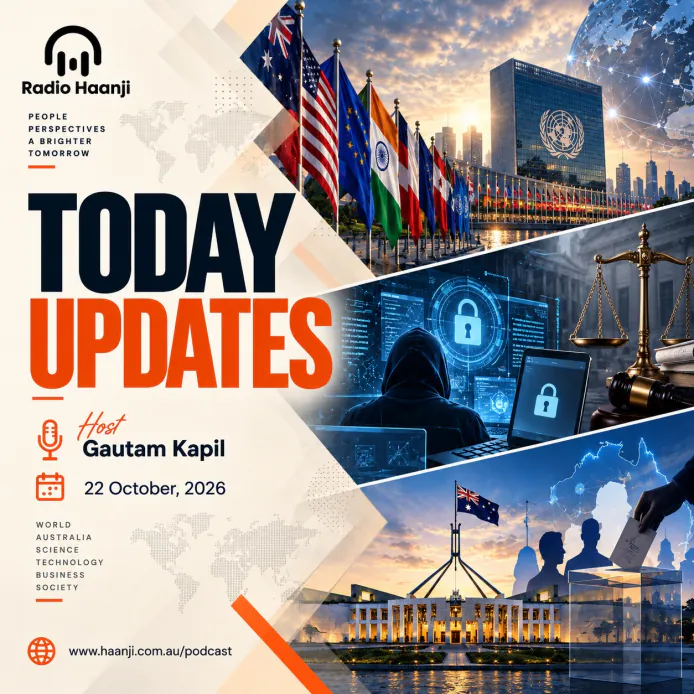
22 Oct - Today Updates - Geopolitical Shifts and Australian Policy - Gautam Kapil
Host:-
 Gautam Kapil
 covers the Badr Accord, global diplomacy, Meta legal verdicts, Australian independent politics, and Sydney Metro updates on Radio Haanji.
International diplomacy and regional power structures are witnessing notable realignments. In this edition of Today Updates on Radio Haanji, host Gautam Kapil analyzes major shifts across global diplomacy, strategic defense alignments, corporate transparency, community security, and critical domestic developments in Australia.
Shifting Alliances in the Middle East: The Badr Pact
Middle Eastern geopolitics continues to evolve rapidly in the aftermath of regional conflicts. As nations re-evaluate traditional security arrangements, fresh defense cooperation agreements are emerging across Asia and the Middle East.
Following previous diplomatic discussions such as the Mecca negotiations involving Saudi Arabia, Turkey, and Pakistan, a new four-nation initiative termed the Badr Accord has surfaced. This initiative brings together Turkey,Pakistan, Qatar, and Indonesia to explore enhanced defense and security collaboration. Under this framework,participating nations are focusing on joint defense manufacturing, equipment interoperability, military capacity enhancement, and strategic intelligence exchange.
These developments signal a practical recalibration in regional security policy. For comprehensive conversations on strategic global trends and scientific perspectives, explore The Deep Talk Show.
Global Diplomatic Engagements and Strategic Positioning
High-level international diplomacy continues to address the ongoing conflict in Eastern Europe. Russian officials have indicated theoretical openness to trilateral discussions alongside Washington and Kyiv scheduled for after 10 November. Concurrently, diplomatic channels confirmed an agreement regarding the release of US citizen Stephen Hubbard, who had been detained in Russia.
Simultaneously, extensive diplomatic visits have been coordinated globally:
-
Special envoy Steve Witkoff held discussions focused on Eastern European diplomacy.
-
US Secretary of State Marco Rubio concluded high-level strategic and trade dialogues in India, emphasizing non-interference in sovereign domestic political processes.
-
Regional security discussions continued regarding peace and navigation stability across key commercial corridors.
In bilateral economic news, delegations visited Reliance Industries facilities in Jamnagar, Gujarat, examining ongoing cooperation in the energy sector. Commercial ties continue to expand, with the US supplying significant liquefied petroleum gas (LPG) imports to Indian markets alongside discussions regarding future refining ventures.
To follow continuous reports on global affairs and Indian regional developments, tune in to Today Updates and Indian Updates.
Digital Privacy, Domestic Legal Scrutiny, and Cyber Protection
Corporate responsibility and digital rights have come under legal scrutiny in the United States. A New Mexico jury ruled against Meta, imposing a 25 billion dollar penalty concerning consumer data transparency stemming from earlier data handling and political consulting controversies.
Meanwhile, security and civil rights concerns were raised by more than 100 US lawmakers, led by Representative Raja Krishnamoorthi alongside figures such as Pramila Jayapal, Ro Khanna, and Ami Bera. The coalition addressed formal inquiries to federal authorities regarding security at places of worship following an armed incident near the Sri Venkateswara Swami Temple in Aurora, Illinois, alongside growing concerns regarding targeted online hate campaigns.
In financial cybersecurity, Indian authorities and banking institutions initiated audits following reports of unauthorized customer data exposure on dark web forums, underscoring the ongoing need for robust digital protection frameworks.
For culturally grounded storytelling and literary reflections, visit Kitaab Kahani and browse thoughtful everyday stories in The Notebook.
Australian Politics: The Role of Independent Representation
In Australian domestic affairs, independent crossbench representation continues to challenge standard party alignments.Discussions led by figures such as Senator David Pocock have drawn public attention to the economic footprint of large foreign data centers operating within Australia.
Key points raised include:
-
Foreign tech data centers consume substantial domestic power, water, and infrastructure resources.
-
Current projections indicate major commercial revenues by 2030, raising questions regarding proportional corporate taxation.
-
Proposals suggest introducing a dedicated annual levy, potentially generating dedicated funding streams for national initiatives such as the Housing Australia Future Fund.
Simultaneously, community safety and security protocols for public officials have returned to legislative discussion following recent physical threats and incidents targeting political representatives across Victoria and Western Australia.
Legislative Innovations and State Infrastructure
State parliaments across Australia are advancing distinct regulatory frameworks and public services:
-
Natural Organic Reduction Legislation: The New South Wales Parliament has passed legislation providing a legal framework for natural organic reduction (human composting), establishing terramation as a carbon-neutral alternative alongside burial and cremation, with an 18-month implementation timeline.
-
Public Transit Infrastructure: Sydney transit networks achieved an operational milestone with the extension of the driverless Southwest Metro line connecting Sydenham through to Bankstown, expanding convenient everyday public transit access.
For light-hearted community discussions and balanced lifestyle listening, enjoy Laughter Therapy and check out community dialogues on Boys Meetup.
Frequently Asked Questions
What is the Badr Accord discussed in Today Updates?
What did Senator David Pocock propose regarding data centers in Australia?
What new post-mortem option was legislated in New South Wales?
Which public transit line in Sydney received an upgrade?
What's Your Reaction?